Nothing is more frustrating than being in the middle of a video call and experiencing choppy, pixelated picture or audio.
Or, if you’re trying to update your computer or gaming system, and that download loading bar is barely headed toward 100%.
Or, streaming your favorite show, only to keep getting the spinning wheel that speaks the universal language of buffering.
To troubleshoot, you pull up a speed test and hit the big “go” button. Numbers appear, and they look fast, but there are half a dozen different measurements. What does it all actually mean?
What is a speed test?
An internet speed test measures the download and upload speeds of your internet connection and shows more than just how fast your internet is. It breaks down your connection into a few different numbers that can help explain how online activities feel day to day.
What do the different speed test measurements mean?
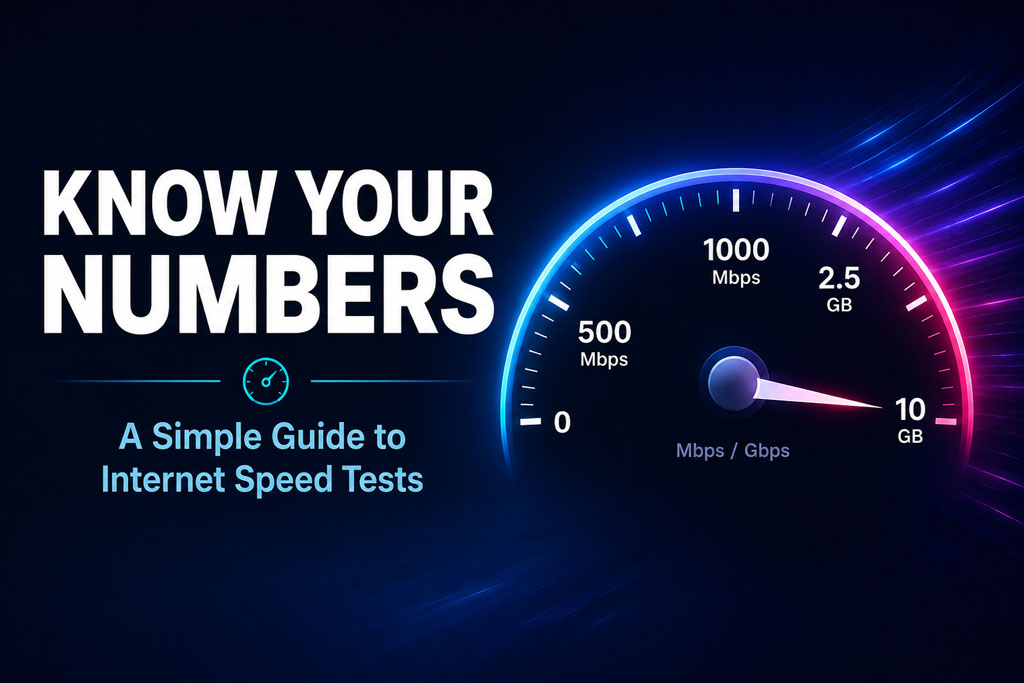
In general, a speed test will contain three basic measurements: download, upload, and ping/latency.
Download speed is how fast data comes to your device. It’s what controls how quickly pages load, videos buffer, and files arrive. This affects streaming, browsing, and system updates.
Upload speed measures how fast data leaves your device. Every video call, cloud backup, and shared photo depends on it.
Ping/latency is the time it takes for your devices to communicate with the internet. Lower ping means faster reactions. Higher ping means you might experience that frustrating half-second lag on calls and games.
With technologies like cable, 5G Home Internet, or low-earth-orbit satellites like Starlink, you’re more likely to see varying speeds and higher ping times. These types of services market “speeds up to” to account for factors that affect the quality of their speed delivery, including weather or network congestion from other users online.
With technologies like fiber, your download and upload speeds should be very close to the internet package you subscribe to. For example, if you are on a Citynet 1000Mbps/1000Mbps plan, your download and upload speeds should measure very close to 1000Mbps if everything in the test environment is perfect. Even with technologies like fiber, you will always see some small variance in your speeds and ping/latency due to several outside factors, but we’ll discuss more on that later.
Some advanced speed tests also measure additional metrics, including jitter and packet loss.
Jitter measures how consistent your ping/latency is over time. Even a fast connection can feel choppy if jitter is high, and it’s usually the source behind broken audio and freezing video.
Packet loss is data that never reaches its destination. Even small amounts of lost data can cause buffering and dropped connections.
Together, these numbers paint a picture of your connection: not just how fast it is, but how stable and responsive it really is. Even so, several factors in your home can affect the numbers you see in a speed test.
What should you consider when running a speed test?
Before you read too much into your results, keep in mind that a few factors can affect what the test measures.
First, run your test multiple times. Speeds can vary minute to minute, depending on what else is happening on your network. Test at different times of the day, like mid-morning versus the evening, to get a more accurate picture of your typical experience.
Where and how you run the test matters just as much as when. Testing over WiFi introduces variables that have nothing to do with your internet service, such as the age of your router, how far you are from it, or how many walls are between you.
For the most accurate reading, connect your computer directly to your router with an Ethernet cable and run the test from there. If your wired speed looks good but your wireless speed is slow, that tells you the issue is likely with your home WiFi setup, not your internet service.
The device you test on can also skew your results. An older laptop or one with a lower-quality wireless chip may not be able to receive the speeds your connection is capable of delivering. If you can, test across multiple devices and compare.
There are also several free tools you can use. Speedtest.net is one of the most widely used options. Citynet’s Managed WiFi app also includes a built-in speed test that measures performance right at your router, which can be a helpful way to compare against a device-level or WiFi-based test.
One last thing to keep in mind: a VPN can significantly slow your speed test results. If you run your internet through a VPN, either pause it for the test or run a second test without it, and compare the results.
When should you call your internet provider?
A speed test is a valuable troubleshooting tool, but knowing how to interpret the results is just as important. If you consistently see speeds that are significantly lower than your subscribed plan while connected directly to your router with an Ethernet cable, it may be time to contact your internet provider. Testing with a wired connection helps eliminate common WiFi-related factors, such as distance, interference, or device limitations. If the issue persists across multiple tests and devices, your provider can help identify and resolve any service-related concerns.
It is also worth a call if you have checked your Managed WiFi app and confirmed that no individual device is hogging bandwidth, but speeds are still slower than expected across multiple devices simultaneously.
If your wired test looks fine but your wireless experience feels sluggish, that could point to a signal issue between your router and your devices. We can help diagnose whether a router upgrade or a whole-home mesh WiFi system would make a difference.
If speeds look normal on the test but something still feels off, like calls still drop or video still stutters, share those details when you call. Jitter, packet loss, and ping/latency can tell a story that download and upload speed alone cannot.
A speed test is a great first step when something feels off.
But if the numbers don’t look right, or you are not sure what you are looking at, give us a call at 800.881.2638. We’re here to help.