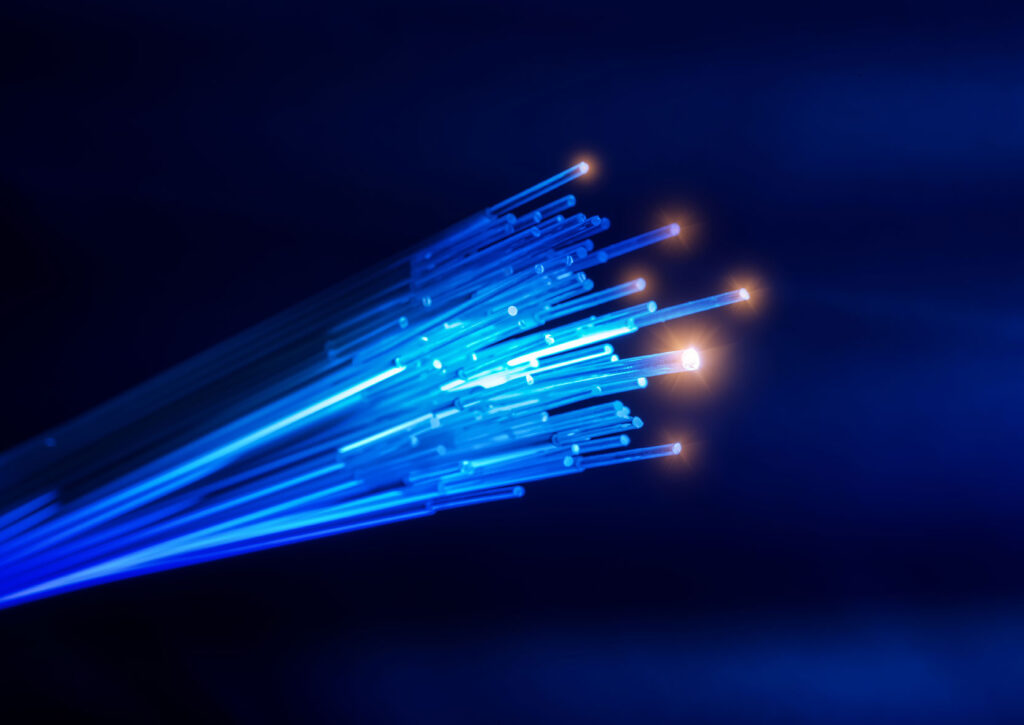
Fiber optics are a revolutionary technology changing how we communicate and transmit data. Here are a few interesting facts about fiber:
- Small but strong: Fiber optic cables are incredibly strong and durable, despite their small size. They have more than eight times the pulling tension of a traditional copper wire.
- Powerful without electricity: Fiber optics use light instead of electricity to transmit data, which makes them non-conductive. This means they are less likely to generate heat and catch fire.
- Sustainable technology: Fiber optics are made from glass or silica, the second most abundant element on Earth (oxygen is the first). This means there is no risk of running out of materials to make fiber optic cables.
- Can handle the weather: Fiber optic cables are not affected by weather or changing temperatures, unlike copper wires. This makes them a more reliable option for long-distance transmission.
- Increases home value: A study by the University of Chicago and Carnegie Mellon University* found that gigabit fiber can add an average of 3.4% to a home’s value. That’s $6,800 added to the price of a $200,000 home! All without any of the usual costly and labor-intense projects such an increase in value would usually require.
- Safe: Fiber optic cables are one of the safest ways to transmit data. They don’t emit electromagnetic energy, making them harder for hackers to intercept.
- Energy-efficient: Fiber optics are a very energy-efficient technology. They require less energy to transmit data than traditional copper wires.
- Resilient: Fiber optic cables are more resilient than copper wires. They are not affected by weather conditions or electromagnetic currents, which can cause copper wires to deteriorate quickly.
- Incredibly small: Fiber optic strands are incredibly small. Standard fiber-optic strands are only 0.125mm or 0.0005 inches in diameter.
- Fiber has layers: Fiber optic cables have layers that help them function correctly. The cable’s center contains the glass strands that carry the light signals. The next layer is a protective coating that shields the fiber strands from interference. The cable’s outer jacket ensures that the light stays in the fiber strands and adds another layer of protection.
- “Future-proof”: Fiber technology is often described as “future-proof” because it has several characteristics that make it well-suited to meet the demands of future internet applications. Fiber optic networks can be easily scaled to meet the demands of increasing traffic, and as mentioned above, fiber cable is not as prone to deterioration as with other methods; Fiber optic cables are very durable and can withstand harsh environmental conditions. This means they are less likely to be damaged by storms, floods, or other natural disasters. The future of the internet is wireless, and fiber is the best technology for providing wireless connectivity because fiber can provide high-speed, low-latency connectivity over long distances.
For all these reasons, it is clear that fiber technology is the future of internet connectivity. Fiber is the best option if you are looking for a reliable, high-speed, and future-proof internet connection.
Learn more about the Citynet Fiber Network! Click here, or contact us, and let’s chat!
Call us anytime at 1.844.CITYNET (844.248.9638).
* The findings of this study were based on data from home sales, the Census Bureau, and the National Broadband Map.